Causes, not symptoms.
The technique still matters — but it only works when the foundation underneath it is right.
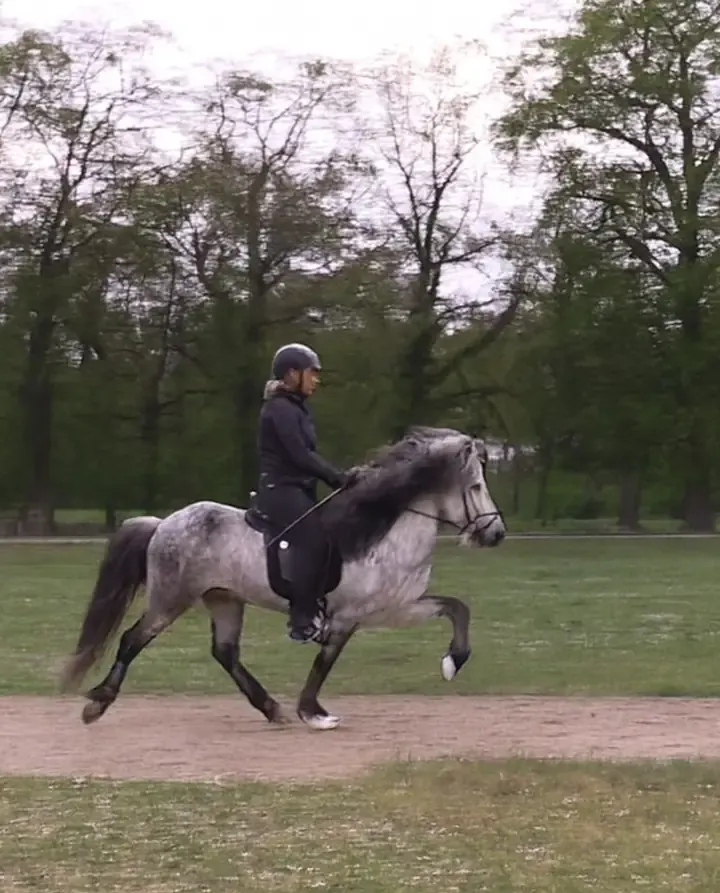
A tense horse. A rider trying to help. More leg, more hand, more collection — and the horse gets more tense.
Not because anything is being done carelessly. Because collection is being asked for before the conditions are actually in place — and the usual response is to add more of what wasn't working in the first place.
Most riding education teaches the exercise: what to do, in what order, with which aid. GaitAcademy starts one step earlier — with why a horse responds the way it does, so the exercises that follow actually make sense, in the saddle, with the horse in front of you, not just on paper.
That's the whole difference. The technique still matters — but it only works when the foundation underneath it is right.
What the foundation is made of
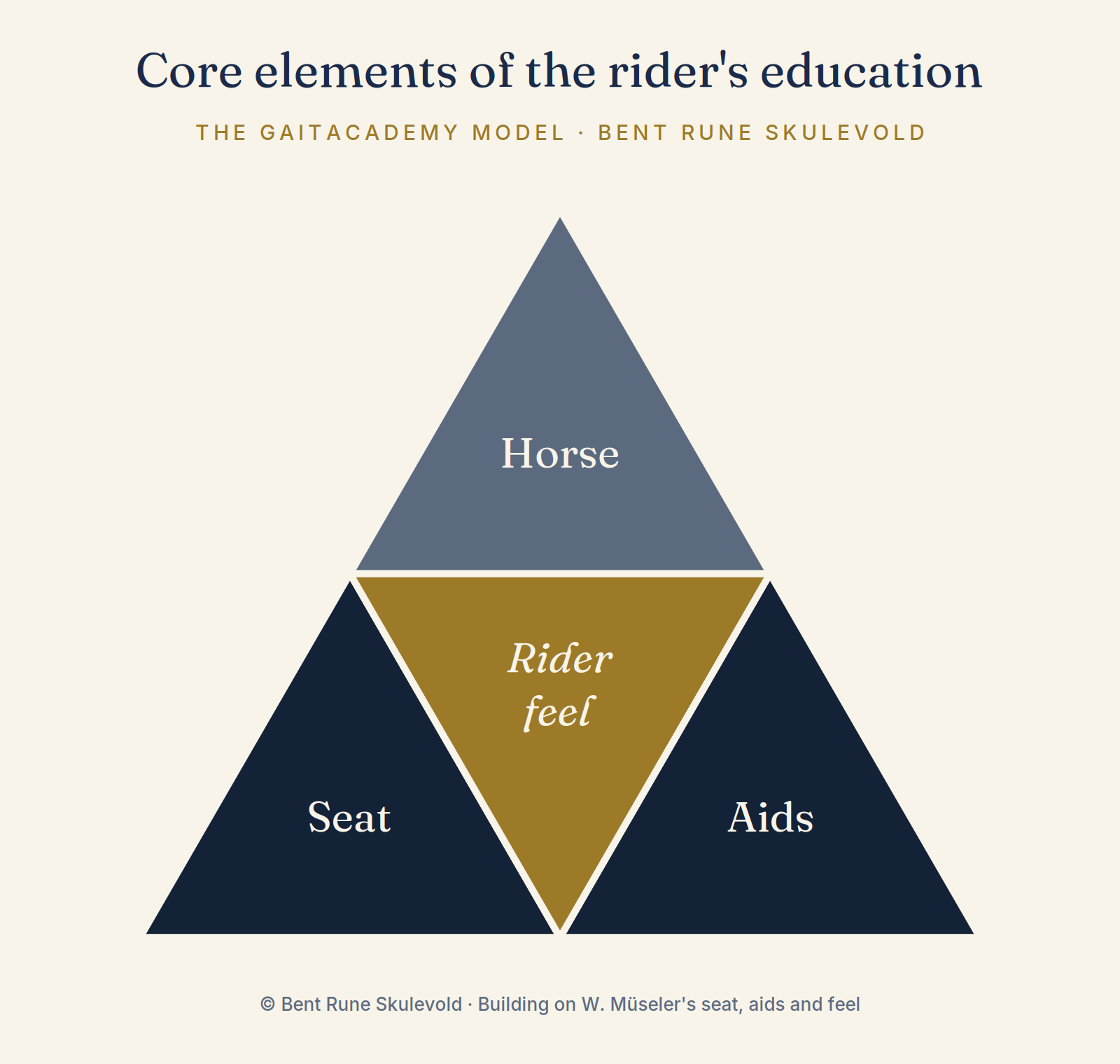
Three things have to be understood, and they are not the same subject.
How the horse learns. A horse's body and nervous system are not a machine that receives instructions. Tension, crookedness, a broken gait — none of these are disobedience or bad luck. They are what a body produces when it's asked for something it isn't yet prepared and ready to give. Understanding the underlying reasons — the why — changes what you ask for, how, and when.
How the rider learns. Riding is not learned the way facts are learned, which is why reading more does not produce feel. It's learned through experience, under conditions where the right thing becomes noticeable — and it develops in stages, where the different capabilities are not separate tracks but connected, each stage making the next one possible. Knowing which stage you're actually in is worth more than knowing what the stage above looks like.
How the two interact. The horse-and-rider pair is not a horse plus a rider. It's the coupling between them: two nervous systems influencing each other continuously, mostly below the level of conscious thought. This is where riding actually happens, and it's the part almost no education addresses directly. It is also why everything in GaitAcademy is built around developing the rider's feel — the most critical point of interaction there is.
Where this comes from
GaitAcademy is not built on one method. It draws on established best practice, the classical tradition, and current science — and on a small number of thinkers who explain, better than riding literature does, why inside-out development works and symptom-chasing doesn't.
John Dewey showed that people learn through their own experience, and that a teacher's real work is to shape the conditions that experience happens in. Rider feel is not like the flu — you can't catch it from someone, and it can't be handed over. It grows in the rider's own body, on their own horse, when the conditions are right.
Michael Polanyi showed that we know more than we can tell. Real riding knowledge is largely tacit: it can be developed, but it cannot be handed over as a procedure — which is why a list of instructions never produced feel in anyone.
Dorothy Heathcote showed that a learner's frame — who they understand themselves to be while learning — changes what the same activity produces. A rider working as someone following instructions and a rider working as someone developing understanding are doing different things, on the same horse, in the same exercise.
Albert Bandura showed that what people believe about their own capability decides what they attempt. The rider who avoids being seen, or stays with the familiar format, is usually protecting themselves from a test they fear they'd fail — not choosing what works.
Otto Scharmer showed that most listening is downloading: we hear what confirms what we already know. That's why a rider can know every term and still not change — and why something new only lands when it's experienced, not recognised.
Aristotle called practical judgement phronesis: knowing the right thing to do in this particular case, which cannot be reduced to a rule. That is what a good rider actually has, and what an exercise library cannot give.
Henrik Herlau showed how such judgement is built. Given the right conditions, and knowledge gathered systematically enough to become dense — viscous, in his term — rather than a collection of facts, phronesis becomes possible: sound judgement in the moment, and the kind of intuition that can be trusted.
Dewey, Heathcote and Ken Robinson — who argued all his life that education should create the conditions in which people flourish — share one conviction: learning happens through experience, under the right conditions, not through being told. That's The Approach in three names.
What follows from it
If this is right, then education has to be sequenced rather than collected, and it has to reach the individual rider's actual situation — not the average one.
That is what the stages of the NextLevel Rider Education are for.